Showing posts with label Weather and Climate. Show all posts

Saturday, December 24, 2011

Philippines Hammered by Typhoon Washi

Philippines President Benigno Aquino declared on December 20, 2011 that the state is imageconfronted with a national calamity as flash floods and landslides triggered by a typhoon took close to  1,000 lives and left tens of thousands homeless.  Typhoon Washi (local name: Sendong) lashed through Southern Philippines on the evening of December 17, with accompanying downpours and strong winds that brought massive flooding and landslides in the Northern Mindanao area. The winds reached up to 80 km/hr and gusts of up to 90 km/hr, and the storm made its landfall in the Northern Mindanao area.


As of December 20, the official death toll stands at 957, with anotherimage 49 people reported as missing. Most of the dead were asleep amidst raging floodwaters tearing through their homes due to swollen rivers. Water cascaded from mountain slopes after 12 hours of pounding rain in the southern Mindanao area. Weather experts highlighted that Typhoon Washi dumped more than a month of average rainfall within 12 hours over Mindanao. Furthermore, the flash floods coincided with high tides.
Most of the deaths stemmed from a coastal village in Illigan. Houses were swept seawards by floodwaters while people were asleep when the typhoon struck. The worst-hit areas were the cities of Illigan and Cagayan de Oro. About 60 people were reported to have been plucked from the ocean off El Savador City, about 10 km north-west of Cagayan de Oro.
The rescue operations was sustained by approximately 20,000 soldiers but efforts were hampered by inundated roads and downed power lines. To aggravate matters, streets were overwhelmed with mud and piles of debris. Regions hit by Typhoon Washi were unaccustomed to typhoons as the area is usually spared from the worst damage. The Philippines is subject to around 20 typhoons annually.
The disaster agency revealed that more than 338,000 people in 13 provinces were affected by the typhoon. More than 10,000 houses were ripped by the typhoon and flash floods. Many schools, roads and bridges were battered. imageMore than US$340,000 worth of crops (mostly rice and corn) were damaged but the Agriculture Department responded that losses were minimal as the crops just entered the initial planting phase. The National Disaster Risk Reduction and Management Council estimated that there are around 35,000 people seeking shelters in evacuation centres, as of the evening of December 18. 
President Aquino allowed the government to access funds from international financial institutions, including US$3 million from the Asian Development Bank (ADB) and around $500 million of low-interest loans obtained from the World Bank (WB). The declaration of a national calamity by the President enabled the government to obtain larger pools of funds for relief and rehabilitation.
Cagayan de Oro and Illigan are now battling to prevent disease outbreaks in crowded, cramped evacuation centres. Digging of graves to bury decomposing bodies have been undertaken. Many of the dead bodies in parlous were left unclaimed, suggesting that the entire families had perished in the disaster. Given  that mortuaries were unable to cope with the overwhelming numbers of dead bodies, the authorities have initiated the digging of mass graves to bury the victims of the calamity. The occurrence of Typhoon Washi had exposed that it is imperative that more efforts are required to ensure early warning systems are inherent in the age where climate change is intensifying the impacts of typhoons. 


References:

Friday, January 14, 2011

Floods devastating Australia

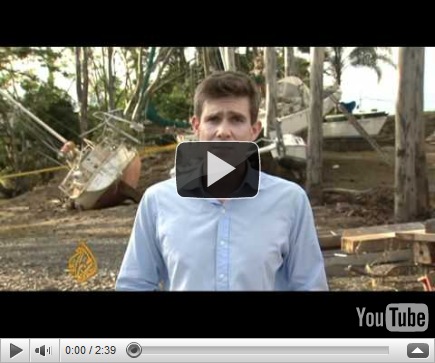
Australia is now plaguedimage with one of the worst floods in 50 years due to torrential rainfalls brought about by the influence of La Nina and a tropical cyclone. Floods have hit Australia since December 29, 2010 and as of January 6, 2011, the flood waters have inundated more than 40 towns and even threaten the survival of corals at the Great Barrier Reef as tonnes of sludge enter the sea and threaten the living environment of the corals which require pristine, clear waters in order to thrive.

With more than two weeks of torrential rainfalls have hit Australia, causing floods in Queensland and Brisbane. In Rockhampton, a regional centre of Queensland, which lies on the Fitzroy River, saw the river peaked at 9.2 metres. Rockhampton’s airport was closed when itsimage runways went underwater. The inundation also cut off the access to main roads and railways leading to the city and disrupted power supplies. Warnings were given out by the authorities to alert residents of marauding crocodiles and venomous snakes were flushed from their habitats as they are searching for dry grounds. Floods that hit Queensland since January 2, 2011, had inundated an area of the size of France and Germany, which is 85,000 square kilometres. More than 200,000 people had their homes destroyed by the floods. The economy of Queensland have been badly hit as the mining and agricultural sector have been disrupted by the floods and caused damages of upimage to billions of dollars. Queensland’s tourism industry  have also been badly devastated as it is among the top tourist destinations in Australia, given attractions such as the Gold Coast stretch of beaches and the Great Barrier Reef. There will be a significant loss of tourist dollars amounting to hundreds of millions of dollars,with many people cancelling their visits to Queensland.

On January 12, 2011, Brisbane was hit by torrents of water due to the image convergence of the raging waters. The floods that affected Brisbane, Australia’s third largest city, are the worst to hit the city in a century. The Brisbane River which runs through the city, was a fast moving torrent of brown, murky water filled with debris. Flash floods were also witnessed in towns that are in close proximity to Melbourne. The city of Brisbane was shut down as the flood waters swamped into the city centre, unleashing an ‘inland tsunami’ on the Central Business District (CBD) area of Brisbane, transforming the dry streets into a watery ghost town of concrete towers. The overall scale of flooding in Australia had a dampening effect on its thriving economy. The Australian dollar dipped to its lowest level since the onset of the floods. It is estimated that the floods could diminish 1% of the country’s Gross Domestic Product (GDP), standing at around A$13 billion. In Brisbane, more than 15,000 homes and shops were destroyed by the floods and about 45,000 people were evacuated from their homes. With the receding of waters in the Brisbane River, the authorities have divided the city into 5 clean up zones and the police have been roped in to facilitate in the regulation of traffic, helping with the clean-up and preventing looting.

001

References

Wednesday, December 15, 2010

Heavy Rainfall and Snow – The Influence of La Nina

La Nina refers to the cooler than ocean-atmosphere phenomenon which is responsible for the colder than usual waters in the equatorial Pacific Ocean and concomitantly influences weather patterns across the globe.  image La Nina enhances the humidity level and the livelihood of rain in the Indo-Australian region while regions such as Peru and Chile experience dry conditions. In 2010, downpours and strong wind gusts have lashed across Indonesia, even in the traditional dry season between March and September. Malaysia is bracing itself for floods as heavy rains across Malaysia had brought flooding and reduced visibility. Devastating floods also haunted Pakistan and China due to torrential and prolonged rainfall. Australia is wrecked by the effects of La Nina as it’s most populous state – Sydney, experienced rains that swept the eastern coast of Australia, producing the wettest August-to-October period on record.

Due to La Nina, Europe is now confronted with freezing temperatures and blinding snowfall. imageSeveral people have already die as a result of the exposure to sub-zero temperatures  and there were also disruptions to air traffic in  Britain, Switzerland and Germany. Some airports such as Gatwick Airport in Britain had been forced to close for 2 days till December 3, 2010 with the deterioration of weather conditions. Train networks have also been halted and highways have become blocked. The current winter that affected Europe is the worst early winter in almost 2 decades. Besides the effect imageof La Nina, the early winter had also exposed the trend of extreme weather pattern and sharper fluctuations in temperature, a phenomenon attributed to climate change.


References:

  • The Straits Times (August 20,2010).'Extreme weather forecast for region
  • The Straits Times (December 3, 2010). ‘Frozen Flights
  • The Sunday Times (December 5, 2010).’Weather Woes

Sunday, August 22, 2010

Devastating Floods in Pakistan


Pakistan has been subjected to the worst floods in 80 years in the summer season of 2010, affecting close to 20 million people, one-eighth of Pakistan's population. Flooding started on July 22, 2010 in the Baluchistan province. The swollen waters later poured across the Kyber-Pakhtunkhwa Province in the northwest before flowing southwards into Punjab and Sindh. 

As of September 6, 2010, death tolls were hovering between 1,300 to 1,600. The devastating floods were attributed to the arrival of the monsoon rain and the effect of climate change, generating large volumes of water and floods in the Indus river basin. The absence of a sustainable adaptation framework in Pakistan to mitigate such climate change induced calamities further aggravates the level of devastation in the nation.